Getting important information to parents can be harder than it sounds—especially when you rarely see them face-to-face. Here are the simple communication layers we use to help families stay informed without making everything more complicated than it needs to be.
Communication matters in every area of life, but I have found that Student Ministry creates some unique communication challenges. Think about it.
At least in our ministry, students normally get dropped off, walk into the Student Center, and check themselves in.
That means I may see a student every single week and almost never see their parents.
We have new students fill out a card with their information, but I am always surprised by the number of students who don’t know their address, their parents’ phone numbers, or their parents’ email addresses. That can create a problem pretty quickly.
How do you communicate with parents when you rarely see them?
We also have quite a few students who don’t attend our church on Sunday mornings, so I can’t rely on catching their parents at church either. And sending a flyer home with a teenager? Let’s just say I have found plenty of those flyers lying around the Student Center after everyone leaves.
If I’m honest, parent communication is an area where we are constantly thinking, evaluating, and trying new things. We haven’t completely “figured it out.” But we have found a few things that seem to work well for us, so I wanted to share them. And hopefully this can become a conversation too. If you’ve found something that works in your ministry, I’d love to hear about it.
Texting
We use several forms of digital communication in our ministry. We post information on our church’s Facebook and Instagram pages, but we also heavily utilize a texting service. That system was already in place when I arrived at my current ministry, and it may be our most effective form of communication.
Our contact list includes both students and parents, and we send weekly texts with updates, upcoming events, service opportunities, reminders, and other things happening in our Student Ministry. We have found that when we need people to sign up for an event or service opportunity, we normally get a much better response after sending a text.
We’ve also noticed more interaction with texts than with many of our social media posts. I think part of that comes down to convenience. Families are busy. With a text, the information goes directly to them. They don’t have to open Facebook, happen to see our post, or remember to check another website. The information is sitting right there on their phone.
Texting is also incredibly useful when something changes at the last minute. This past winter, we had three weeks when we had to cancel programming because of weather. That’s a lot for us. Each time, we were able to send a text alert to everyone.
If your ministry doesn’t have some kind of texting system in place, I highly recommend looking into one. It doesn’t have to replace everything else you use. For us, it has simply become one of the fastest and easiest ways to get important information in front of students and parents. It has also helped me communicate better because a text forces me to keep the information short and to the point.
I use email a lot.
Since I sit at a desk for much of the day, I actually enjoy communicating through email. I can include all the information I need, attach documents, and see everything right on my computer. The problem?
Email might be one of the most inconsistent forms of communication out there.
Some people are like me. They check their inbox several times a day—or maybe several times an hour. Other people seem to check their email about once every six months. Or their inbox is so full that an important email easily gets buried.
Still, there are times when email is exactly what we need.
We use email when the information is too important or too detailed to squeeze into a short text. For example, we send an information packet to everyone attending our JH retreat. There are normally several attachments and quite a bit of information, so email works well.
We also use email when we want to prepare parents for something their students will be discussing. A few years ago, we taught a series about relationships. The final week focused on romantic relationships and the biblical importance of saving sex for marriage. We didn’t want parents surprised by that conversation. So we emailed them about three weeks ahead of time. Then we sent another email the Wednesday before the message.
We explained what we were discussing, reassured parents that the topic would be handled appropriately, and let them know our teaching would be based on what Scripture says.
For something like that, a quick social media post isn’t enough. Email gives us room to communicate clearly.
But Don’t Assume They Read the Email
This is where I have had to get a little creative. For our JH retreat, after I send the detailed email, I will often send a text saying something like:
“Parents: Important JH Retreat information was just sent to your email. Please take a few minutes to check it.”
Now I’m using one communication method to point people toward another. I’ve also taken the body of an important email, turned it into a PDF, and texted families a link to it. The information still gets communicated in a longer format, but parents can access it directly from their phones.
Printed Materials
Printed materials might be the trickiest option for us.
There are few things more frustrating than spending time creating a handout for parents, giving it to students, and then finding a pile of those handouts sitting around the Student Center after everyone leaves. Students forget things. That’s just reality. So I don’t think it’s very effective to rely completely on students to get important paperwork home.
But that doesn’t mean printed materials are useless.
Sometimes we still want something physical in a parent’s hands. One thing we changed was when we hand things out. Instead of giving students a flyer earlier in the night, give it to them as they leave. Stand by the door and place it in their hands as they’re walking toward their vehicle. Hopefully, they can make it from the door to the car without losing it!
We also occasionally mail materials directly to families. We’ve mailed newsletters, retreat information, and information about upcoming teaching series. Overall, we have tried to make more of our communication digital because I think it reaches families faster and is more convenient. But I wouldn’t completely underestimate the value of something printed.
Sometimes an actual piece of paper sitting on the kitchen counter does something a notification on a phone doesn’t.
OVER COMMUNICATE — But Keep It Simple
This may be the biggest lesson I have learned about communication in Student Ministry. When I say overcommunicate, I don’t mean send families a 12-paragraph text message every day. I mean:
Don’t rely on one communication method.
Use layers. If we put something important on Facebook, there will probably also be a text reminding families about it. For something big like our JH retreat, we may:
announce it on social media, send a text blast, send a detailed email, and mail eligible students an information packet.
Is that repetitive? Absolutely.
But people communicate differently. Some parents live in their email inbox. Some respond almost immediately to texts. Some are constantly on Facebook. Some aren’t on social media at all. If the information really matters, I would rather a parent think:
“Okay, Neil, I get it. The retreat registration is due Friday.”
than say:
“I had no idea registration was due.”
The key is to keep each individual message simple. You don’t have to put every detail in every communication method. A text can simply say:
“Registration closes Friday. Click here for details.”
Then the link can take them to the full information. Use your communication methods together instead of expecting one method to do everything.
Communication Is Still a Work in Progress
Communication is important to every ministry, and I think churches can struggle with it from time to time. I know we do. We’re still learning. We’re still trying different things. And I’m sure the way we communicate five years from now will look different from the way we communicate today.
But one thing I have learned is that important information shouldn’t have only one path to the people who need it.
Text it. Email it. Post it. Print it when necessary. Keep it clear. And don’t assume that because you said something once, everyone heard it.
Like most things I share on Pastor in Practice, this isn’t a perfect system. It’s simply what we’re learning in practice.
How does your church communicate with parents and students? What method has been the most effective for your ministry? I’d love to hear what’s working for you in the comments.
-
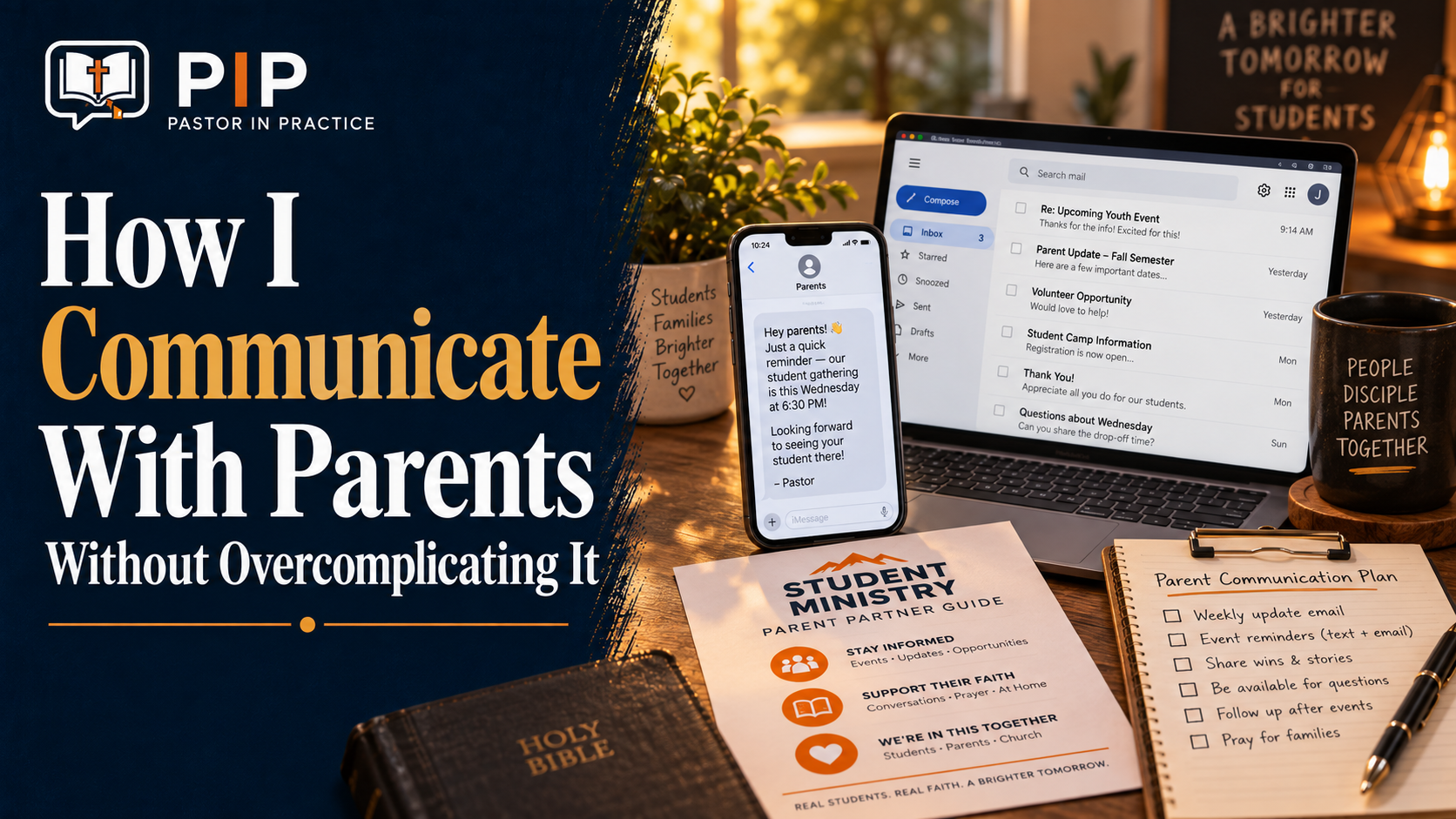
How I communicate with Parents without overcomplicating it
Getting important information to parents can be harder than it sounds—especially when you rarely see…
-

Why Pastors Need Rest: What a Family Getaway Reminded Me About Ministry
Rest isn’t a distraction from ministry—it can be part of what keeps us healthy enough…
-
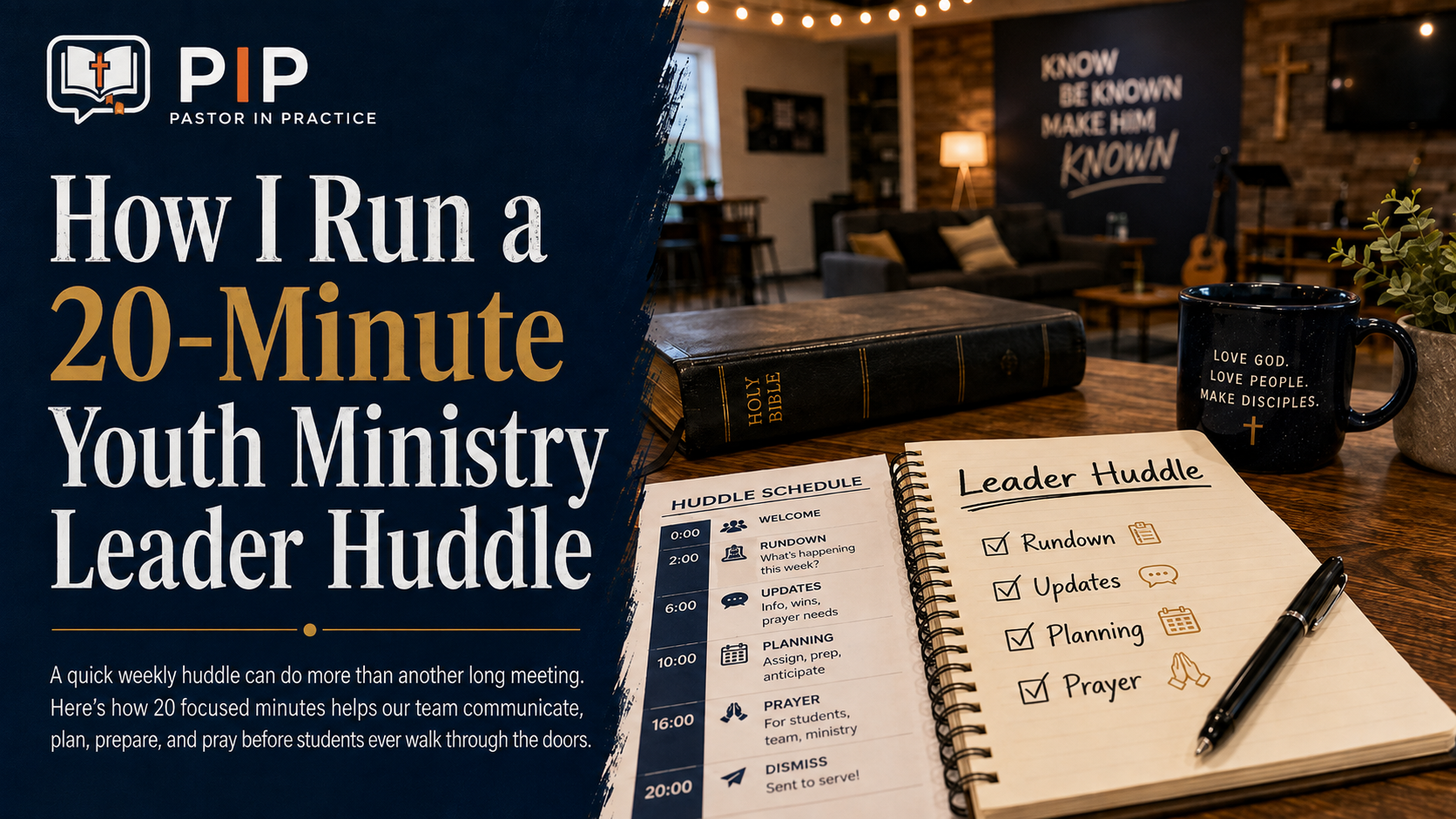
How I run a leader Huddle
A quick weekly huddle can do more than another long meeting. Here’s how 20 focused…
